
In this Article
- When the Twelfth Fixed Circular Costs More Than the Case
- Changing Tip Size on a Live Cord When the Swatch Disagrees
- Threads, Keys, and Steel Cables: Where Stitch Flow Breaks
- Spare Cords at the Underarm, in the Pinhole, and Across a Wrap
- Counting Your Fixed Circulars Before Buying a Case
Every knitter I know has a project bag with a needle in it that has no business being there. It is the right size and the wrong length. It was bought for one sweater, and it never found a second job. That orphaned circular is where the economics of a luxury interchangeable set begin, and it is the right place to start any honest conversation about whether a case is worth its price.
When the Twelfth Fixed Circular Costs More Than the Case
At what point does buying one more fixed circular for a new cast-on become more expensive than owning a complete luxury interchangeable kit?
The answer depends on the cord lengths a single sweater actually occupies. A sleeve and a neckband want 40 cm. The body wants 80 cm. Once the yoke or a shawl border outgrows the body, you need 100 cm. Those three lengths, multiplied across the millimeter sizes your projects share, are the real shopping list.
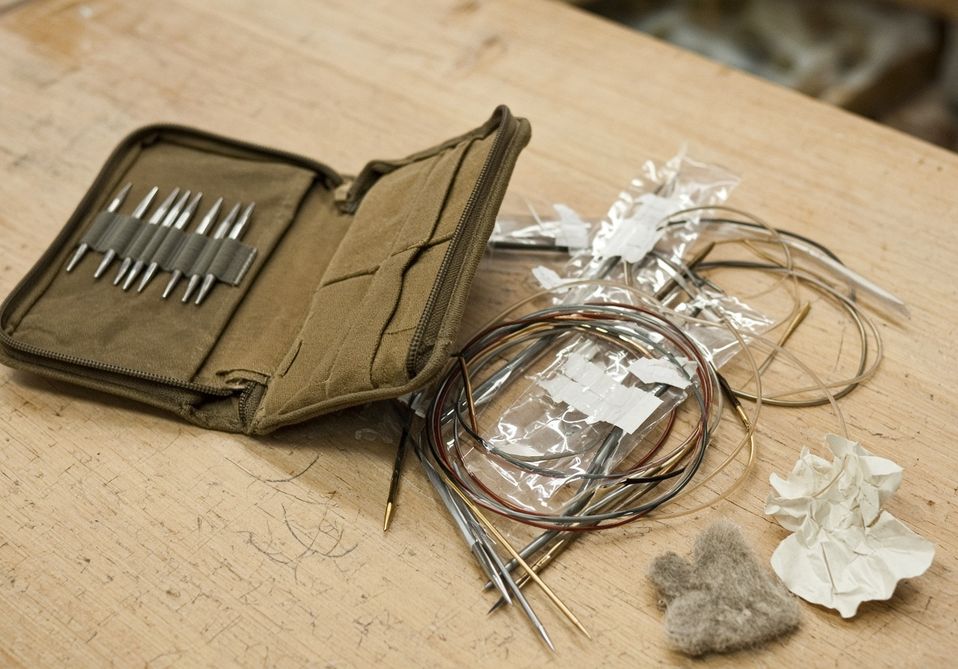
Premium fixed circulars in 40 cm, 80 cm, and 100 cm lengths commonly sell for $14 to $18 each. A luxury interchangeable case with nine tip pairs and four or five cords commonly lists at $189 to $219. Now count. Four sizes (3.5 mm, 3.75 mm, 4.0 mm, and 4.5 mm), each in three cord lengths, makes twelve fixed circulars. At that per-needle range, the stack totals $168 to $216, which is where project-by-project buying meets the price of the case. Add 5.0 mm in the same three lengths and you hold fifteen needles worth $210 to $270, past the case entirely, before a 120 cm shawl needle ever enters the picture.
When I tallied my own project bags, the pattern was blunt. A sweater-hat-shawl rotation from January 2023 through June 2024, at one garment cast-on every 8 to 14 weeks, accumulated exactly that stack. The same 4.0 mm tip appeared on a 40 cm cord that could not reach around a yoke, and again on a 100 cm cord that was useless for a sleeve.
That duplication is the hidden cost. The short-cord copy sits idle in the bag whenever the yoke needs 100 cm, and the long one waits out every cuff. You paid twice for one millimeter size.
One honest qualifier belongs here. If you knit every project on a single 80 cm cord inside a two-size band, your duplicate spending never overtakes a full case across that same eighteen-month stretch, and a case would be a luxury purchase in the plainest sense.
Changing Tip Size on a Live Cord When the Swatch Disagrees
Picture the evening. A 10 cm worsted swatch has taken 30 to 45 minutes to knit, then rested 12 to 24 hours. You measure, and the stitch gauge is off by just enough to matter. The pattern now wants 4.5 mm where you used 4.0 mm, and the 4.5 mm you own sits on a 40 cm cord, too short for the body. The fix costs an evening plus the wait for a shop.
With an interchangeable set, the correction becomes a tip change on the cord already holding the work. A half-step in this band runs from 4.0 mm to 4.5 mm; on lines that cut 0.25 mm increments, a quarter-step from 3.75 mm to 4.0 mm is possible. Unscrewing one tip and seating the next is quick with the key in hand. Moving 200 to 280 live yoke stitches, or 48 to 72 sleeve stitches, onto a different fixed circular takes longer, with every slipped loop a chance to drop one.
The same logic carries through a whole garment. Body fabric worked at 4.5 mm can move to collar, cuff, and hem tips at 3.75 mm or 4.0 mm on that same cord, with no transfer at all. If you are ever unsure how a metric tip maps to US sizing, the Craft Yarn Council standard needle size conversion tables are the reference to keep open.
Mismatched tips for tight rounds
Only the right-hand tip forms the new stitch. The left-hand tip merely enters loops that already exist. So a left tip set 0.25 mm or 0.5 mm smaller than the working tip slips into snug stitches more easily without rewriting the gauge the right tip establishes. On yoke rounds, I pair a 4.0 mm left tip with a 4.5 mm right tip, and the tight decreases stop fighting back.
Swap Before You Rip
If the swatch is off by a half-step, change the right-hand tip on the live cord and knit one more measured round before deciding to start over.
Threads, Keys, and Steel Cables: Where Stitch Flow Breaks
Stitch flow fails at the join and along the cable, because that is where tension concentrates. Everything that separates a luxury set from a budget one shows up at those two points.
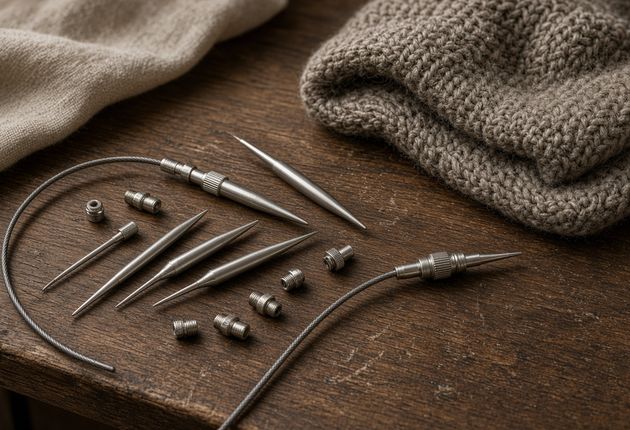
Start with the thread. A roughly cut thread leaves a small lip at the join, and that lip catches mohair halo and single-ply silk. One caught halo fiber at a proud join can stop a round of 180 to 240 stitches until you back the tip off and free the strand. A precision-machined thread seats flush and presents no edge to snag.
Then the seating. A join tightened only by fingers can loosen during a dense worsted yoke, because each round keeps torque on the cable. The tightening key finishes what fingers start: the rubber grip pad holds the tip still, and the key adds about a quarter turn past finger-tight. Past that point I trust the join through a 200-stitch worsted round; short of it, I check every few rounds.
Mohair Snag Warning
A join that feels secure in the hand can still back out under a dense yoke. Key every seat a quarter turn before knitting halo or single-ply yarns.
Cables matter as much as joins. Nylon-coated multi-strand steel in 60 cm, 80 cm, and 100 cm lies flat once unwound. Cords that hold their packaging coil can take several evenings of knitting before the curve relaxes, and until then the stitches ride up and twist.
Matching tip material to fiber
- Stainless: slippery silk and linen blends.
- Laminated birch: mixed worsted with moderate grab.
- Bamboo: grippy rustic wools.
Taper differs by size band too. Lace-sharp points in the 2.25 mm to 3.25 mm range use a different taper from the blunter points at 4.0 mm to 5.5 mm.
Spare Cords at the Underarm, in the Pinhole, and Across a Wrap
The extra cords in a case earn their keep in jobs that only work because the tips come off.
Parking sleeves for a try-on
At the underarm divide of a top-down sweater, screw end caps onto a spare 40 cm or 60 cm cord and it becomes a secure holder for 52 to 68 sleeve stitches while the body continues on the active tips. A try-on is practical once 4 to 8 cm of body hangs below the underarm, often in week 3 to week 6 of a sweater that runs 8 to 14 weeks. Because the cord is flexible and capped, you can pull the whole piece over your head and check ease at the bust without a single stitch at risk.
Laying lifelines automatically
The tightening pinhole already passes through the join. Thread unwaxed dental floss or smooth scrap yarn through it, and the strand draws forward with each stitch you knit, laying itself in as you go. Set one every 8 to 12 rows, or at each increase ridge on the yoke, and a ripped-back mistake stops at a clean row.
Linking cords for wraps and blankets
Two 60 cm cords joined by a connector approximate a 120 cm run, enough for a wrap carrying 280 to 450 stitches in fingering or sport weight. Place the connector at a side edge, where stitches bunch least, rather than at center front.
Counting Your Fixed Circulars Before Buying a Case
Before any case enters your cart, sort what you already own. Material and point sharpness predict daily use better than anything else, so they come first:
- Separate lace points at 2.25 mm to 3.25 mm, garment points at 3.5 mm to 5.5 mm, and sizes at 6.0 mm and above.
- Note whether each tip is stainless, laminated birch, or bamboo.
- Within the garment band, mark which millimeter size repeats most. For worsted garment work it usually clusters at 4.0 mm to 4.5 mm.
Then test small. Join feel and taper only reveal themselves under your own tension on a real swatch, which is why a single pair of tips plus one cord makes the right trial unit. If the taper suits you, that pair stays useful inside a full case later.
Your Repeat Size Decides
The size you duplicate most is the size to test first, on an 80 cm cord.
Tonight, empty every project bag and pull out each fixed circular. Write down how many times each millimeter size appears on 40 cm, 80 cm, and 100 cm cords. Then buy one pair of interchangeable tips and a matching 80 cm cord in your most-repeated garment size, and knit your next swatch on it with the join keyed a quarter turn past finger-tight.





Discussion
No comments yet. Be the first!
Write a Comment