
In this Article
- Why old leaflets added one skein for every three
- Flat knit grids against stacked crochet nodes
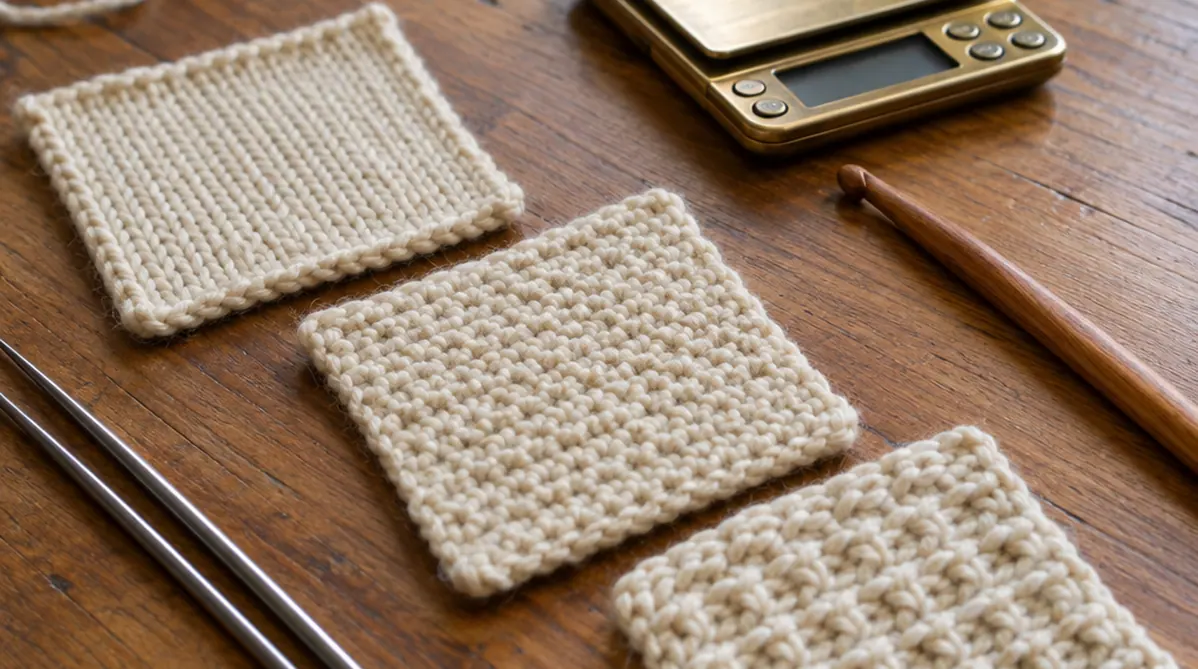
- Three worsted squares on a kitchen scale
- Bigger hooks, chain spaces, and the pinched golden loop
- Buying your next crochet project by the gram
A crocheter at a yarn shop counter is told, kindly and with total confidence, to grab a few extra skeins "because crochet eats yarn." She does. Months later, half of them sit in a bin, unused and from a dye lot she will never match again. I hear versions of this story constantly, and it always starts with the same inherited arithmetic.
That arithmetic deserves a closer look, because the real answer to "how much yarn will this take?" lives in your stitches, your hook, and a cheap kitchen scale.
Why Old Leaflets Added One Skein for Every Three
The extra-skein habit has no inventor. It travelled through ball bands and leaflet shopping notes as repeated counter advice, never as a recorded trial. Fiber-content lines became routine on commercial balls after the late-1930s labeling rules, and from the late 1940s through the early 1960s, pattern leaflets printed yardage and gram callouts as a matter of course.
Alongside those numbers sat the shopping instruction: one extra skein for every three the leaflet listed, applied to the whole project, with no stitch measurement attached.
Consider what crochet looked like in many homes at the time. Household cotton was commonly size-10 thread worked on steel hooks between 1.0 and 1.75 mm, often landing near 7 to 11 stitches per 2.5 cm. Bedspread squares were lightly starched and pressed until they dried stiff. That is a specific fabric class: fine thread, tiny hooks, and dense, board-like cloth. It truly was yarn-hungry, and its reputation stuck to the whole craft.
The worsted put-ups that later replaced those thread balls commonly come in 50 g or 100 g, with a 100 g worsted band typically printed somewhere in the 165 to 200 m range. The fiber, the hook, and the fabric all changed. The rule stayed. Stitch geometry, the hook-to-needle ratio, and fabric thickness predict yarn use far better than the word "crochet" on a pattern cover.
Flat Knit Grids Against Stacked Crochet Nodes
Start at the loop path. Stockinette builds a flat grid, one loop drawn through one loop, row after row. On a 4.5 to 5.0 mm needle in worsted, conventional stockinette often settles near 18 to 20 stitches and 24 to 28 rows over 10 cm.
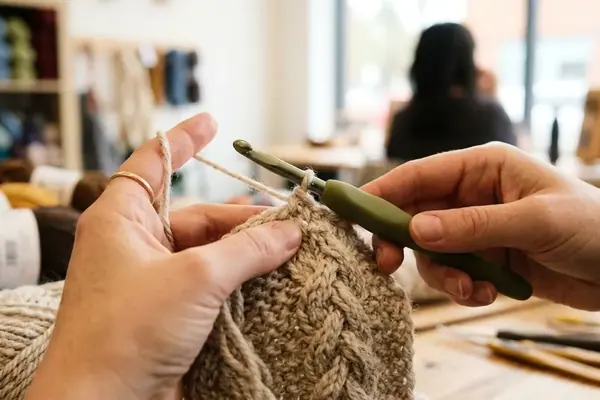
Single crochet behaves very differently. Each stitch draws a loop through the previous row, then pulls through the loop already sitting on the hook. The strand crosses itself at the head and again in the post. Pick up a single crochet swatch beside a stockinette swatch in the same yarn and you can see and feel it: the crochet node is thicker, a small stack of yarn resting on itself and on the row below.
How taller stitches spend yarn on height
Double crochet uses yarn differently. Each double crochet contains more wraps than a single crochet, yet its taller post means fewer of those dense base nodes fill the same 10 cm of height. A double-crochet row in worsted on a 5.0 to 5.5 mm hook, with the vertical loop left at full stitch height, often measures 1.1 to 1.6 cm. So 10 cm of fabric may hold 6 to 9 rows of double crochet against 14 to 18 rows of single crochet.
Fewer rows means fewer thick nodes per square, which shifts the weight-to-area ratio in a way that a craft label could never predict.
Three Worsted Squares on a Kitchen Scale
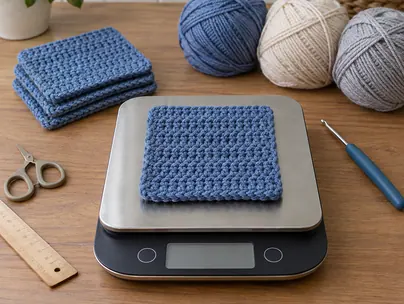
This is the test I ask every student to try once, because it settles the argument faster than any chart. You are recording a rank, and the yarn itself checks your work.
- Use one skein. Work all three pieces from a single 100 g worsted skein in one dye lot, so the grist stays identical across stockinette, single crochet, and double crochet.
- Make them big. Chain or cast on enough to block each piece to at least 20 cm on a side. You will measure only a 10 cm × 10 cm interior, keeping curled edges outside the weighed area.
- Wait for true dryness. Working the three squares commonly takes 50 to 80 minutes. Wool then needs 18 to 36 hours laid flat to reach a stable dry weight; acrylic or cotton in a room at 18 to 22 °C often settles in 8 to 14 hours.
- Weigh twice. Use a digital kitchen scale that reads to 0.1 g, then weigh again 12 to 18 hours later. A lower second reading means the first one still held water.
- Unravel and measure. Pull out each dry interior square and run the strand along a meter stick. The longest recovered length should belong to the heaviest dry reading.
At relaxed, conventional tool pairings, the single crochet square usually ranks heaviest and thickest, with the least drape. Double crochet tends to land lighter and looser, and stockinette is thin and supple with the smoothest hand of the three.
Your Hands, Your Numbers
Hand tension and hook material change loop circumference enough that someone else's chart, even in the same yarn and the same nominal millimeter, will not predict your grams per 10 cm square. Weigh your own blocked square every time.
Bigger Hooks, Chain Spaces, and the Pinched Golden Loop
Hook size also changes yarn use. Many crocheters converting a knitting pattern match the hook to the needle millimeter for millimeter. A hook matched to a 4.5 mm or 5.0 mm needle squeezes the crochet node, which needs more room than a knit loop in the same strand. The fabric compresses, and yarn use climbs.
Stepping the hook up by 0.5 to 1.0 mm (a 5.0 mm needle paired with a 5.5 mm or 6.0 mm hook) usually restores comparable drape in worsted.
Openwork pushes things further. Moss stitch, with its alternating chain-1, or granny clusters separated by chain-1 or chain-2 spaces, can come in lighter per blocked area than cabled or brioche knitting in the same worsted. Cables cross stitches over one another and brioche doubles the fabric, so on those projects the knitter may be the one who should buy extra.
Spotting a Strangled Loop
The golden loop is the vertical pull-up loop in taller crochet stitches. When it is over-tightened, it sits in the throat of the hook instead of standing at stitch height. Row gauge may then run 2 to 4 rows extra per 10 cm, and short, pinched posts show on the back of the work. Your hands notice too: the hook drags or squeaks, the edges cup, and the cloth feels board-like before it ever reaches the blocking mat.
Every one of those extra rows quietly spends yardage, and no skein-count shopping habit can see it happening.
Buying Your Next Crochet Project by the Gram
Stop adding an automatic third to your shopping list. Retire it completely, whether you are converting a knitting pattern or planning a crochet blanket from scratch, and let the scale do the job.
- Work a true 10 cm × 10 cm blocked square in your actual pattern stitch. A 5 cm scrap lets edge stitches dominate the reading. Expect 25 to 40 minutes of hook time.
- Let it dry for the fiber's window, anywhere from 8 to 36 hours, then weigh it.
- Divide your target area by 100 cm². A 120 cm × 150 cm throw is 18,000 cm², so you multiply the dry swatch weight by 180.
- Round that total up to the next full skein in the put-up on the shelf, 50 g or 100 g.
- If two dye lots are available, buy the whole rounded total from one lot in a single visit.
Grams Over Ball Bands
Printed yardage tells you how long the strand is. Your swatch weight tells you how much of that strand your stitches will actually swallow.
My recommendation is firm: make the weighed swatch a non-negotiable step, as routine as checking gauge, and buy by grams every single time. You will skip the white-knuckle rounds of yarn chicken, and you will stop collecting lonely single skeins. One square, one scale, one honest number, and your yarn budget finally reflects the fabric you love to make.

Discussion
No comments yet. Be the first!
Write a Comment