
In this Article
- Defining the Fiber Arts Workflow System
- Evaluating Organizational Portfolios for Pattern Management
- Assessing Modular Accessory Storage for Notions
- Analyzing High-Capacity Totes for Large Projects
- Maintenance Protocols and Material Care
- The Organizational System in Practice
Defining the Fiber Arts Workflow System
A knitting project bag is a specialized containment and transport system engineered specifically to protect active fiber arts projects from environmental damage while preventing yarn tangling and securing delicate tools.
That definition matters because a project bag is not just a prettier grocery tote. A good one has to sit beside a chair without slumping, keep a cake of yarn from rolling under the sofa, and give sharp tools a place to live where they will not chew through a half-finished sleeve. When general bags are used on sloped floors, yarn spillage becomes the predictable nuisance: the ball rolls, the strand tightens, and a calm row turns into a hunt under the table.
The evaluation here uses three criteria: material integrity under repeated handling, structural design during active knitting, and maintenance requirements after real use. These are modest criteria, but they are the ones that show up when a project moves from sofa to car to guild table and back again.
Why one bag rarely solves the whole project
A sweater does not ask for the same organization on cast-on day as it does during sleeve separation. A colourwork chart asks for flat reading. A lace project asks for stitch markers that can be found without dumping the whole bag. A blanket asks for capacity and a base that will not collapse under its own weight.
The stronger approach is a small workflow system: one vessel for the project, one portfolio for the pattern, and one modular home for tools & notions. This evaluation is limited to active project transport and flat-lay reading, not long-term archival storage or display shelving.
Summary: The best knitting project bag setup is less about owning more accessories and more about matching each stage of the project to the right kind of containment.
Evaluating Organizational Portfolios for Pattern Management
The Cocoknits Project Portfolio stands out in this group for pattern and publication management because it solves a plain, recurring problem: paper moves. Loose sheets curl. Magazine pages flip shut. Digital patterns still need marked notes, row counts, and the occasional printed chart when the screen glare becomes tiresome.
Its primary material, washable Kraft paper, gives it a character that feels closer to a well-used leather notebook than a disposable folder. It begins crisp and firm. After a handful of gentle wash cycles, the surface softens and develops more texture, which makes the portfolio feel less precious and more like something meant to travel.
The spine elastic does the real work
The defining mechanism is the spine elastic, designed to secure loose-leaf patterns or bound publications. In flat-lay reading, that small strip of tension matters. Laine Magazine Issue 7, released in early 2019, is the kind of bound issue that tests whether a portfolio can hold pages open without constant hand pressure. The Cocoknits elastic keeps the publication from sliding out of position while the knitter checks a chart, counts a repeat, or compares notes in the margin.
That may sound minor until the project is colourwork. A late-2018 Lapland colourwork reference, for example, demands steady chart visibility. The knitter should be deciding between yarn floats and colour changes, not pinning a magazine open with a coffee mug.
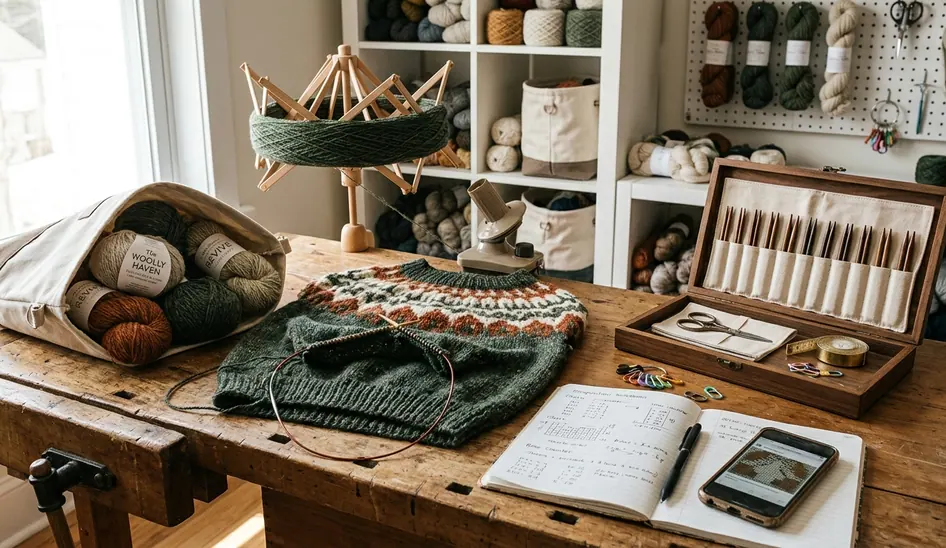
The portfolio also separates pattern management from yarn storage. That separation is easy to undervalue. When paper rides inside the same cavity as yarn, needles, scissors, and snacks from the last community & events meetup, the pattern loses first: corners bend, pages wrinkle, and charts pick up lint.
Quick Tip: Use the portfolio for the active pattern only. Archived knitting patterns belong somewhere flatter and calmer, away from project-bag traffic.
Assessing Modular Accessory Storage for Notions
If the portfolio handles the reading, the Cocoknits Accessory Roll handles the tiny interruptions: stitch markers, tapestry needles, cable needles, scissors, progress keepers, and the spare bulb pin that saves a dropped stitch at the worst possible moment.
The roll works because it treats notions as separate working tools rather than one jangling pile. Its structure uses snaps as the primary mechanism for attaching individual pouches to the outer wrap. Each pouch attaches via three snaps spaced roughly 4 cm apart, which gives the connection enough alignment to feel intentional rather than fiddly.
Single-pouch removal changes the pace
The key advantage is selective access. A knitter can remove one pouch of stitch markers without disturbing the pouch holding tapestry needles or the pouch holding scissors. That sounds like a small ergonomic win, but it keeps the project table from turning into a spread of loose metal and plastic.
There is a limit worth naming. Modular snaps fail to align when pouches exceed three per roll, so the system works best when it stays edited. This is not the place for every duplicate notion in the house. It is the place for the tools the current project actually needs.
The material choice helps. Like the portfolio, the Accessory Roll is constructed from washable Kraft paper. It holds up against repeated contact with tapestry needles, and it gives small scissors a more durable surface than soft cotton linings often provide.
Note: Sharp tools still deserve closed tips or cases. Durable material reduces damage risk, but it should not become an excuse to toss uncovered blades into a pouch.
Analyzing High-Capacity Totes for Large Projects
Large projects ask for a different kind of confidence. A sock bag can be charming and still useless for a cardigan. Once the yarn load grows, the bag needs capacity, structure, and a base that respects gravity.
The Fringe Supply Co. Woollelujah! tote bag is the primary vessel here for sweaters, blankets, and other large-scale knitting or crochet projects. Its capacity supports full sweater projects up to around 800 g of yarn, which puts it in the practical range for serious garment work without turning it into luggage.
The gusseted bottom is the quiet hero
The critical design feature is the gusseted bottom. It allows the tote to sit completely flat on the floor or a table, which keeps yarn from spilling out during active knitting. During stability checks on uneven surfaces, that flat base mattered more than extra pockets or decorative hardware.
Canvas gives the Woollelujah! tote a different personality from the Kraft paper accessories. It is more rigid, more capacious, and more willing to stand open beside a chair. The Kraft paper pieces feel like organizers; the canvas tote feels like the room that holds the project.
That contrast is useful. A portfolio should not need to carry a sweater. A tool roll should not need to become a yarn bowl. The tote’s job is broad containment, and the gusseted bottom makes that containment stable while the hands are busy with needles.
Maintenance Protocols and Material Care
Care instructions are not decorative text on a tag. They decide how long a project bag keeps its shape, how the material ages, and whether a spill becomes a patina or a permanent regret.
For the Cocoknits washable Kraft paper products, the recommended cleaning method is a gentle machine wash. That instruction is part of the design, not a reluctant compromise. The texture changes visibly after the first wash, then continues softening over a few more gentle cycles. The result is a material that feels broken in rather than broken down.
Canvas needs restraint
The Fringe Supply Co. canvas tote requires a stricter protocol: spot clean only. Soil contact should be addressed within a day, because waiting gives stains more time to settle into the fibers. Full submersion is the mistake to avoid; the canvas can lose shape if it is fully soaked, and the rigid structure that makes the tote useful may not return cleanly.
This is where the comparison becomes especially clear. Kraft paper rewards washing with softness and texture. Canvas rewards restraint with structure. Treating them the same way would punish one of them.
- Empty the project bag completely before cleaning.
- Brush off loose lint, yarn fuzz, and dust.
- Machine wash Cocoknits Kraft paper pieces on a gentle cycle when softening or cleaning is needed.
- Spot clean the canvas tote only, focusing on the soiled area.
- Let every component dry fully before returning yarn, patterns, or tools.
For knitters who rotate through yarn reviews, techniques & tutorials, and multiple works-in-progress, this care split is easy to remember: wash the organizers when they need softening; protect the tote’s shape.
The Organizational System in Practice
The full system earns its place when the evening has already started and the knitter does not want to assemble a workspace from scratch.
A chair waits near the lamp. The Woollelujah! tote sits on the floor beside it, flat-bottomed and steady, holding the body of a sweater without tipping toward the rug. The working yarn feeds upward instead of rolling away. Nothing dramatic happens, which is exactly the point.
The knitter reaches for the Cocoknits Accessory Roll and unrolls it across the arm of the chair. One pouch comes off in seconds: stitch markers only, no rummaging, no scattered scissors. The other pouches stay snapped in place.
On the lap, the Project Portfolio rests open. Its spine elastic holds the colourwork chart flat through a long evening session, firm enough that the page does not creep closed between rounds. The tote contains the sweater. The roll contains the tools. The portfolio contains the instructions.
Then the knitter lifts the needles, checks the next square of the chart, and carries the contrast strand neatly across the back of the work while the yarn waits in the open tote at their feet.

Discussion
No comments yet. Be the first!
Write a Comment