
In this Article
- What a Matted Underarm Costs After Fifty Hours of Knitting
- Fine Microns, Short Staples, and the Fibers That Wander Out
- Counting Contact Points: How Plies and Twist Hold Merino Together
- Loose Gauge, Lofty Grist, and the Limits of a Harder Twist
- Choose Untreated Worsted-Spun Plies and Knit Them Firm
What a Matted Underarm Costs After Fifty Hours of Knitting
An adult pullover asks for somewhere between 35 and 55 hours of hand-knitting before you ever pull it over your head. By then, four to six hand-dyed skeins have been wound, swatched, knitted, and blocked. That is the stake.
On the sweaters that failed in my wear log, the loss arrived on a predictable schedule. By the third wear, the underarms had matted into a gray-toned fuzz and the side seams had followed. The front and back still looked new, which made it worse: a garment that is ninety percent beautiful and ten percent shabby rarely gets worn with pride.
The opposite outcome is just as concrete. A sweater built from the right fiber, in the right structure, at the right density, keeps crisp stitches under a backpack strap, survives the diagonal rub of a seatbelt every morning, and still reads as handmade rather than worn-out years later. That kind of garment becomes the one you reach for without thinking.
Everything below comes from hand-knit swatches and finished garments worn across three winters, November 2016 through March 2019. I kept notes on where the fabric broke down, what the label promised, and how often those two things disagreed. High-twist Merino was the most common place where they parted ways.
Fine Microns, Short Staples, and the Fibers That Wander Out
Pilling starts with migration. Friction from your arm swinging past your torso works loose fiber ends toward the surface of the fabric. Once there, those ends tangle with one another into tiny knots. The knot stays put because its tail is still anchored to intact fibers inside the yarn.
That anchoring explains why pills on the worn pieces never brushed away like lint. They were tied in.
Why softness and durability pull against each other
Merino earns its reputation for softness through fine fiber diameter. In my samples, apparel Merino in the approximately 15.5 to 18.5 micron band bent and released its ends faster than 21 to 23 micron lots knitted in the same stitch. A finer fiber flexes more easily against skin, and it also flexes more easily out of the yarn.
Staple length compounds the problem. The Merino bases I handled mostly fell in a 60 to 90 mm staple range, while the longwool components I used for comparison commonly ran past 120 mm. Shorter staples mean more fiber ends per inch of yarn, and every end is a potential pill. For readers who want the underlying physics, the American Sheep Industry Association publishes material on fiber diameter and wool curvature mechanics that is worth an evening's reading.
Same Label, Different Clip
Two skeins can share a micron count and a stated weight and still pill on different schedules. Staple strength shifts with grazing season and clip year, and mill lots vary accordingly. Treat any yarn review, including mine, as a description of particular lots rather than a permanent verdict on a brand's base.
Superwash finishing enters here as well. The treatment strips or coats the surface scales that help wool fibers grip their neighbors. Once that grip is gone, a short fine fiber slides out of the yarn with very little persuasion.
Counting Contact Points: How Plies and Twist Hold Merino Together
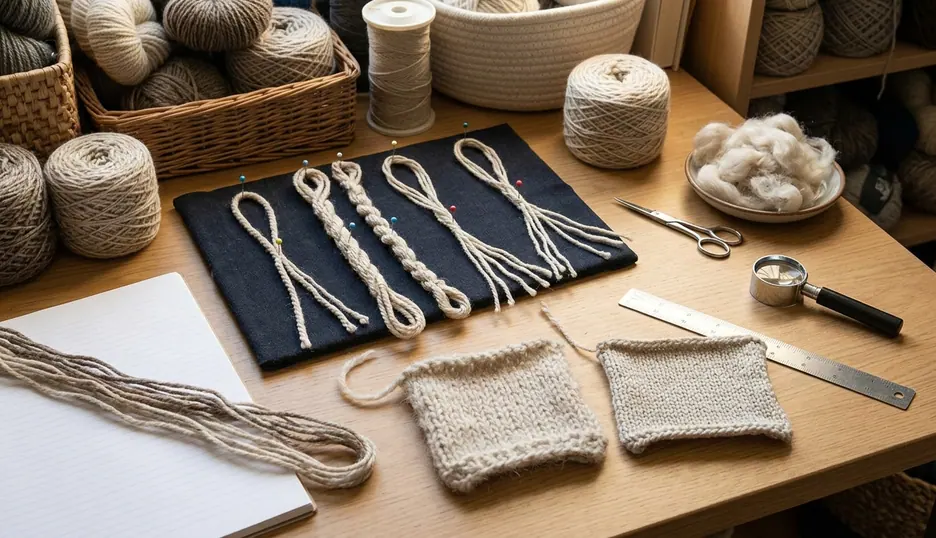
The clearest evidence in the archive came from a single garment. On several sweaters, I had knitted cuffs in a multi-plied high-twist yarn and the body and sleeves in a standard-twist base. After a full November-to-March season, the cuffs still had defined stitch crowns. The elbows, in the same sweater, had blurred edges.
Same wearer, same washing, same winter. The difference was geometry.
Two plies, three plies, four
Each ply in a yarn wraps around the others, and every point where they press together is a place a short fiber end can get pinned. A 2-ply yarn has two strands touching along a single spiral seam. Add a third ply and the strands nest into a rounder cross-section with more pressure points. A 4-ply or cabled construction, where plied strands are plied again, multiplies those contacts further. My 3-ply and 4-ply samples trapped short ends at more points than 2-ply samples of the same weight class, and the wear notes tracked that difference closely.
What twist angle actually does
Twist angle describes how steeply the fibers spiral around the yarn's core; turns per inch is the count of those spirals along a measured length. Higher twist pulls the fiber bundle inward and compresses it. That compression raises the friction between individual hairs, so a fiber end that wants to slide toward the surface meets resistance from every neighbor pressing on it.
Plying direction matters too. Singles are typically spun in one direction, often Z, and multi-ply yarns are plied in the opposite direction, S, which balances the energy and locks the plies against each other. A single-ply yarn has no partner strand to hold its fibers. In my samples, singles haloed under backpack-strap and seatbelt friction even when the strand felt firmly spun between my fingers. Tight spinning slows a single down; it does not give it anywhere to tuck its ends.
Loose Gauge, Lofty Grist, and the Limits of a Harder Twist
High twist on the label settles nothing once the yarn meets your needles. Several high-twist skeins in the archive pilled almost as fast as standard bases, and the cause in each case was how they were knitted.
Gauge opens the door
When a high-twist yarn is worked at an airy drape, a needle size or two looser than a firm fabric would call for, each stitch loop leaves a long exposed float. Friction gets full access to that float and can pluck fibers loose along its length. The twist holds fibers within the strand, but a loose stitch hands that strand to the abrasion with nothing protecting it.
Rub Before You Cast On
Knit a two-inch stockinette swatch at your intended gauge. Give it a series of firm rubs against a rough denim patch. If fibers lift and begin to knot, watch for the same wear at the finished sweater's underarms.
Grist and preparation sit beneath the twist
Grist describes how much fiber is packed into each yard of yarn, and preparation determines how that fiber is arranged. A lofty woolen-spun yarn keeps its fibers jumbled and air-filled before plying. Give it a hard final ply and the outside looks tidy, yet the disorganized fibers inside still migrate outward over time. Worsted-spun yarn combs fibers parallel before twisting, so the ply twist grips an orderly bundle. In my wear notes, the woolen-spun hard-ply yarns shed internal fibers while the worsted-spun ones held.
Where more twist stops paying
Past a firm, even ply, adding twist bought me problems. Stockinette began to bias on the diagonal from the yarn's torque, and the hand grew harsh enough that the softness of fine Merino, the reason anyone buys it, was gone. Neither change closed the gap left by superwash treatment. Once the scales are stripped, extra twist cannot restore the grip they provided, and short fibers keep slipping out.
Choose Untreated Worsted-Spun Plies and Knit Them Firm
Here is the stance three winters of wear support: stop buying superwash high-twist Merino for sweaters you plan to wear hard. For heavy-rotation garments, choose an untreated, worsted-spun 3-ply or 4-ply yarn, or a Merino blended with a longer-staple longwool, and knit it at a firm, dense gauge. Every heavy-rotation sweater that held up in the archive followed that formula.
What to check at the yarn shop
- Bead-like ply definition. Look for tight, rounded plies that sit like a string of small beads along the strand.
- Low halo in the skein. A fuzzy aura on a fresh skein is migration that has already begun.
- Non-superwash labeling. Read the band; if it says machine washable, the scales have been treated.
- Bounce recovery. Stretch a length firmly between your hands and release it. A durable strand springs back.
Shave the First Crop
The first pills on a new sweater are the shortest, weakest surface fibers working loose. Remove them with a sharp sweater stone or blade before they tangle into a mat. In my notes, garments shaved early stayed noticeably cleaner the following winter.
That last habit deserves the same conviction as the yarn choice. Pull those first pills off promptly, then leave the fabric alone. Once the loose short ends are gone, a firmly knitted worsted-spun ply has very little left to give up, and the sweater you spent fifty hours on will look like the one you meant to make for years to come. Buy the bouncy untreated 3-ply, knit it tight, and shave it once.


Discussion
No comments yet. Be the first!
Write a Comment