

The 6:40 P.M. Sit-and-Knit Reality Check
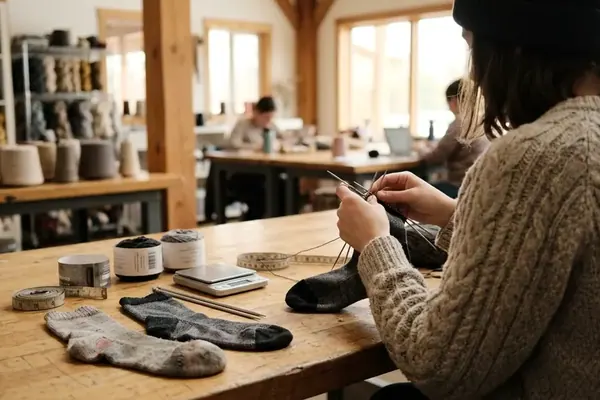
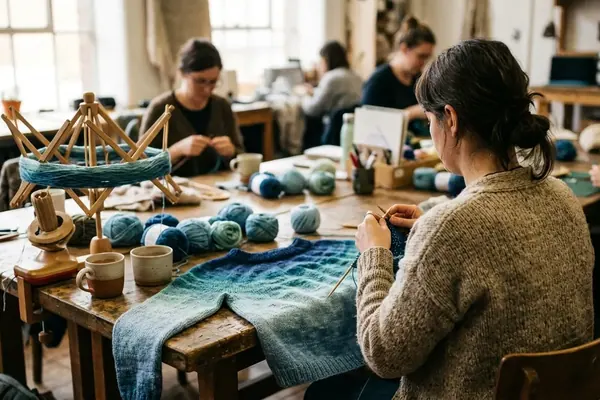
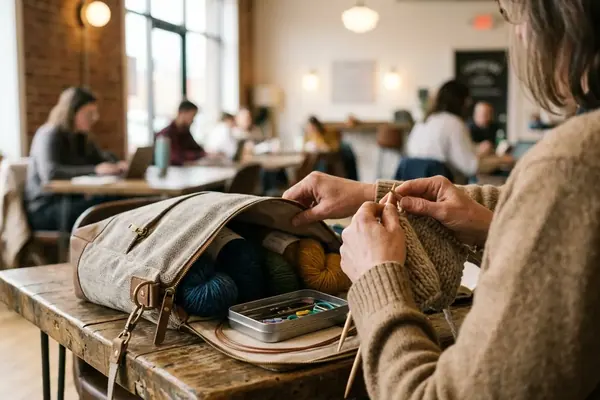
The scene unfolded at a neighborhood sit-and-knit, from 6:40 p.m. until a little after eight, offering a candid look at natural pacing. Two chairs apart sat an English thrower and a Continental picker. Both worked with worsted yarn on 4.5 mm needles, executing matching 40-stitch panels. The visual contrast was immediate and striking. The picker’s left index finger stayed inside a tight, rapid window of movement. An onlooker’s eye reads that compact motion as pure speed. Meanwhile, the thrower’s right hand swept out and back in a rhythmic arc of 8 to 12 cm from the needle tip.
Many English knitters experience a familiar internal monologue in these moments. Watching the blur of a Continental knitter's left hand often breeds a creeping doubt that the natural throwing style is somehow inferior or outdated. The sweeping motion feels leisurely compared to the rapid-fire picking.
Yet the row-end comparison, after roughly half an hour of continuous knitting, tells a different story. Judged by the 40-stitch panels rather than by hand motion, the visual speed of Continental knitting frequently masks the structural and ergonomic advantages of the English throwing method. The two knitters reached the end of their sections at nearly identical times. The perceived speed discrepancy is an optical illusion born from the size of the movement, masking the steady mechanics of the wider throw.
Unpacking the Mid-2010s Classroom Hierarchy
The modern speed myth has distinct roots in recent instructional trends. Beginning-class framing that circulated widely in the mid-2010s heavily influenced how new crafters view their hands. During this period, picking was frequently introduced as the advanced, grown-up method. Throwing was relegated to a starter habit meant to be unlearned as soon as possible. This pairing stems directly from mill and cottage production logic.
Historical production knitting treated stitches strictly as units of output. This environment rewarded keeping the yarn hand inside a short travel band of 2 to 3 cm. Minimizing hand movement was prioritized for sheer volume, creating a standard of efficiency based entirely on industrial output metrics. When evaluating modern yarn reviews or selecting projects, this industrial mindset still subtly influences how crafters judge their own efficiency.
Domestic regional styles functioned as parallel household methods. They were never intended to represent a ranked skill ladder. Crafters across different regions developed techniques suited to their specific tools & notions, local fibers, and daily rhythms. The elevation of the Continental method to the top of an artificial hierarchy ignores the rich, varied history of how fabric was actually constructed in domestic settings.
Biomechanics of the 12-Centimeter Sweep
Unhurried English knitting reveals a complex, multi-joint action. The yarn hand leaves the needle, the wrist extends, and the forearm rotates through a much larger path than a pick. This 8 to 12 cm path from the right needle tip distributes the physical effort across multiple muscle groups.
Load leaves the finger flexors and spreads into the wrist, forearm rotators, and a modest shoulder share—a distribution that prevents localized stiffness. Stiffness that clusters after long micro-repetition at the left index finger is the direct result of keeping the travel band too tight. By engaging the forearm and wrist, the English throw allows for continuous stockinette blocks of roughly 45 to 75 minutes before a stretch break becomes necessary.
Continental pick travel often stays inside a tiny 1 to 2 cm window at the left index finger. While this looks incredibly fast, it forces a small group of muscles to perform thousands of micro-repetitive tasks without relief. The broader movement of the English throw acts as a built-in release valve for hand tension.
Managing the Shoulder Load
Knitters already managing right-shoulder irritation must monitor their posture carefully. To fully benefit from the ergonomic advantage of the throw, keep the shoulder's share of the movement small. If the elbow begins to wing outward, the load-sharing advantage reverses, placing undue strain on the rotator cuff.
Pre-Formation Tension in Fair Isle Floats

Stitch-size consistency relies entirely on locating exactly where tension is set. In English throwing, the yarn is wrapped, then thrown. The right fingers can add or ease wrap tension in the instant before the new loop is drawn through. This pre-formation window supports highly consistent stitch sizing, explaining why beautifully even columns show up in the work of throwers who do not appear to be knitting quickly.
The mechanics of this tensioning are precise. The right-hand yarn path travels over the index finger, with an optional half-wrap at the pinky, before heading to the ball. This setup is remarkably similar to tensioning in crochet, providing a secure grip that allows for constant micro-adjustments while the wrap sits on the right needle.
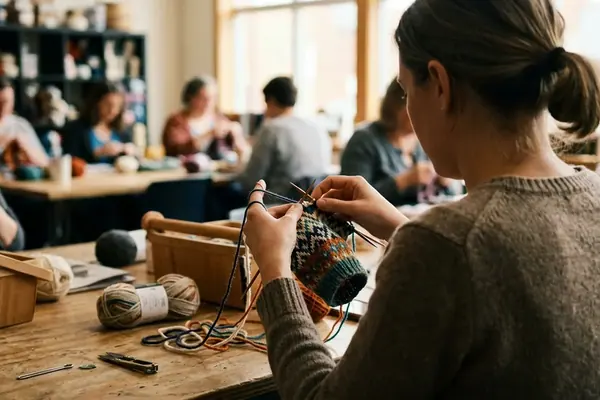
Complex knitting patterns highlight this advantage perfectly. Consider stranded colorwork with one dominant yarn held in the right hand. The thrower maintains optimal tension across Fair Isle floats spanning 5 to 7 stitches on small motifs. Being able to adjust the yarn precisely before completing the stitch prevents the puckering that often plagues colorwork projects. The right hand controls the feed rate with absolute authority, ensuring the fabric architecture remains sound and elastic.
The 25-Degree Pivot: Evolving to the Flick
Crafters looking to increase efficiency without abandoning their dominant hand often discover flicking. Flicking operates as a shortened throw, keeping the yarn firmly in the right hand so existing English tension habits remain intact. It does not require retensioning the yarn on the left index finger and serves as a refinement of the throw, keeping the knitter grounded in their natural style.
The mechanics of the flick center on an index-finger yarn pivot of roughly 15 to 25 degrees. Your right needle stays seated in the hand, while the index finger pivots to lay the yarn over the tip. This hybrid approach maintains the tension benefits of throwing while drastically reducing wasted movement.
What drops out of the process is the interval of approximately 0.8 to 1.4 seconds present in a full, unhurried throw — the time spent when the right hand fully leaves the needle, completes the wide arc, and regrasps the tool. Eliminating it trims travel time per stitch.
Building the Flicking Habit
Transitioning to this movement requires focused repetition. Dedicate a practice block of 20 to 30 minutes of flicking on a plain hat round before returning to a complex project. This isolated practice builds muscle memory without the pressure of following intricate charts.
Your Three-Minute Stockinette Diagnostic
Moving past basic techniques & tutorials requires observing your own hands in action. The most effective way to understand your current mechanics is through a simple recording task. Set up your phone camera in portrait orientation, positioned 40 to 50 cm above your lap. Ensure your workspace is clear of extra tools & notions to provide an unobstructed view of your needles.
Record yourself knitting three minutes of plain stockinette. Do not attempt to knit faster or neater than usual; capture your baseline rhythm. Once recorded, watch the playback at half-speed. This turns your three-minute take into six minutes of highly readable motion.
During this half-speed review, watch for three specific beats: where the right hand fully releases the needle, where the yarn is hunted for, and where the left needle drifts out of alignment. These are the moments where excess motion hides.
For your next session, pick exactly one marked waste motion from your video — say, the regrasp after each throw — and spend 25 to 40 minutes on a plain swatch shaving it down. One motion, one session. That single change, repeated across a sleeve, is what turns the wide, unhurried throw into a flick you can trust.


Discussion
No comments yet. Be the first!
Write a Comment