
Straight needles have a strong grip on knitting culture. They look tidy in a jar, they appear in beginner kits, and they carry the romance of learning from someone at a kitchen table. But romance does not hold a blanket-in-progress at the end of a long row.
The real question is not which needle looks more traditional. It is which tool gives the hands less work to do while the fabric grows.
In this Article
- The Ergonomic Advantage: Rethinking the Beginner's Tool
- Mechanical Profile of Straight Needles
- Structural Dynamics of Circular Needles
- Impact on Tension and Fabric Architecture
- Application Matrix: Matching Tool to Textile
- Next Steps: Executing Your First Circular Project
The Ergonomic Advantage: Rethinking the Beginner's Tool
A new knitter usually receives two straight needles and a ball of worsted wool, then gets told to make a scarf. That advice is familiar. It is not always kind to the wrists.
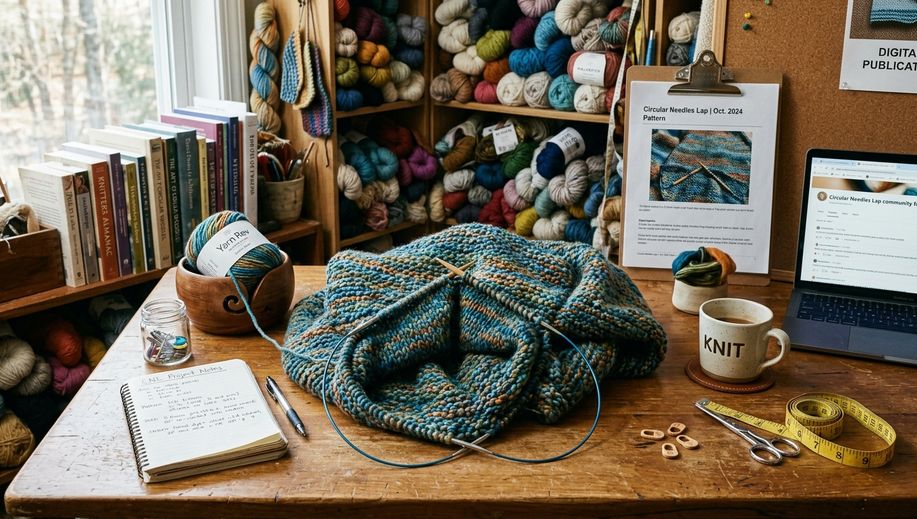
On a 24-inch circular needle, the project begins to behave differently once the fabric has enough rows to hang. In the comparison notes for this article, project weight shifted into the lap after about 15 rows, and wrist torque dropped when the cable rested across the thighs during stockinette. The hands still form the stitches, but they stop acting like shelves.
That shift matters for beginners because the first lessons already ask a lot: hold tension, read the working yarn, steer the tips, and recognize a knit stitch from a purl bump. Adding a growing strip of cotton or wool to the end of a lever makes the lesson harder than it needs to be.
Summary: Tool choice should start with mechanical advantage rather than historical convention. If the project can rest in the lap, the knitter can spend more attention on stitch formation.
What the beginner actually feels
The difference is not subtle. Straight needles put the fabric out from the hand. Circulars let the fabric pool below the hand. For many learners, that changes the mood of the first session from clumsy balancing act to steady practice.
This is why circular needles deserve a place in the first lesson, not just in sweater knitting or advanced techniques & tutorials. The tool removes one source of fatigue before it becomes a habit.
Mechanical Profile of Straight Needles
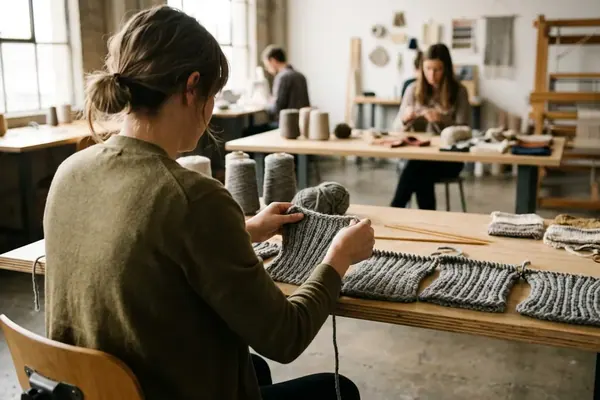
Straight needles work like small levers. Each stitch sits on a rigid shaft, and the growing textile extends outward from the hand. With a narrow scarf in soft wool, that can feel crisp and controlled. With a dense cotton panel, the same setup starts to fight back.
In side-by-side handling, stable width on straight needles began to fade around 8 inches when lever flex grew noticeable. The more memorable workshop moment came with heavy cotton: straight needles bind on projects wider than 10 inches in heavy cotton, especially when the knitter crowds stitches near the tips to keep the row moving.
Where straights still shine
Straight needles are not obsolete. They are excellent for narrow, lightweight pieces: dishcloths, slim scarves, small practice swatches, and garter-stitch strips where the row length stays modest. Some knitters also prefer the tactile stop at the end of each needle. It gives a physical boundary that can feel reassuring during early counting.
The knitting belt changes the equation. Knitters using that technique can stabilize a long straight needle at the hip, which reduces the unsupported lever effect. In the supplied comparison notes, knitting belt users maintained close to 120 stitches without extra support on scarves under 6 ounces. That is a different mechanical system, not a contradiction.
For most modern couch, train, and guild-meeting knitting, though, the straight needle asks the wrist to manage more than stitch formation. It asks the wrist to manage the project.
Quick Tip: If a straight-needle project starts rotating downward between stitches, the fabric is no longer a passive passenger. Move to a circular before the row becomes a wrestling match.
Structural Dynamics of Circular Needles
A circular needle has three working parts: two tips, two joins, and one flexible cable. The tips do the familiar work of entering stitches and wrapping yarn. The cable holds the resting stitches and carries the fabric weight. The joins decide whether the whole tool feels smooth or maddening.
Good joins matter. A rough transition from tip to cable can snag wool, split loosely spun yarn, and slow down crochet-adjacent makers who are used to clean tool travel. In the comparison notes, cable joins held up for roughly 5,000 flex cycles before coating wear, which is useful context when evaluating tools & notions that get packed, twisted, and stored in project bags.
Flat knitting on a circular
The simplest misconception is that circular needles are only for knitting tubes. They are not. To knit flat, work across the row, turn the piece, and work back. The cable bends in between, but the fabric remains a flat panel.
This is the quiet advantage. A knitter can make a dishcloth, scarf, shawl, sweater back, or blanket panel without changing the basic flat-knitting motion. The same needle can then handle hats, cowls, sleeves, and yokes when the project moves into the round.
Small circumferences and Magic Loop
Magic Loop expands that range further. For a small circumference, the knitter pulls extra cable out between stitches so the active stitches sit on the needle tips while the spare cable forms loops. In the provided setup notes, Magic Loop on a 16-inch circumference used a 40-inch cable with about 4-inch tip overlap.
It looks odd the first time. Then the logic lands: the cable is not just a connector. It is storage, suspension, and steering.
Impact on Tension and Fabric Architecture
Fabric tells the truth. A tool can feel pleasant in the hand and still leave a visible track in the cloth.
The most common tension change appears at transitions. On straight needles in worsted wool, the purl-to-knit transition measured a fraction of a millimeter larger in the supplied swatches. That tiny difference can show up as a loose column at the edge of ribbing or a soft ladder where the hands change rhythm.
Working continuously in the round changes the architecture. There is no turn at the row end, no full-row alternation between knit-side and purl-side handling, and less interruption in the path of the working yarn. In the circular swatches, continuous round knitting produced a more consistent gauge after about 10 inches, with noticeably less row-to-row variation in the measured fabric.
The join is part of the gauge story
Needle diameter is only one part of gauge. The transition between tip and cable can slightly resize a resting stitch if the join is abrupt or the cable is too stiff. This is especially noticeable with delicate yarns, singles, and loosely plied hand-dyed skeins featured in yarn reviews, where a snag can stretch one leg of a stitch before the knitter notices.
Note: Circulars reduce wrist strain, yet they require careful cable management and high-quality joins to prevent snagging on delicate yarns.
These observations come from worsted wool and common practice swatches, so they are best read as a tool-behavior guide rather than a universal fabric law. Fiber grip changes the result. A woolen-spun yarn clings to the needle; mercerized cotton slides and drags in different places.
The practical test is simple: knit a swatch, wash it as the finished item will be washed, and look at the transitions. The eye will catch what the ruler only begins to describe.
Application Matrix: Matching Tool to Textile
The right needle is the one that fits the textile in progress. That sounds obvious until a knitter packs a full blanket onto short straights or buys an interchangeable set for one hat.
Choose by width, weight, and grip
- For narrow, light pieces: straight needles remain pleasant for scarves, dishcloths, and small swatches when the fabric does not pull downward.
- For medium flat pieces: a 24-inch circular fits worsted dishcloths up to 9 inches wide and keeps the growing cloth in the lap.
- For heavy cotton or dense fabric: circulars reduce the lever effect and make turning the work less fussy.
- For sticky wool: smooth joins help the stitches advance without tugging.
- For slick plant fibers: a slightly grippier tip may matter more than cable length.
Travel adds another filter. Circular needles take up less side-to-side space, which makes them friendlier on buses, planes, waiting rooms, and crowded community & events seating. Straight needles can jab an armrest, a tote bag, or the patient person sitting nearby.
Temperature can complicate the choice. Circular cable stiffness varies in cold weather, roughly below 60 degrees Fahrenheit, so a cable that behaves beautifully at home may feel wiry at an outdoor market or winter knit night. Warm it in the hands before judging it too harshly.
Interchangeable sets versus single pairs
Interchangeable circular sets are tempting because they promise range. A well-chosen set can cover several yarn weights across a handful of cable lengths, which makes sense for knitters who move between hats, sweaters, shawls, and home goods. The cost-to-utility ratio improves when the knitter already knows those project types are coming.
For a beginner or a straight-needle loyalist testing the waters, one fixed circular is smarter. It avoids the storage pouch, the tightening key, the spare cable decisions, and the quiet guilt of an expensive kit sitting unused.
Start with the tool that answers the next project, not the imaginary shelf of future knitting patterns.
Next Steps: Executing Your First Circular Project
The first circular project should not be a sweater sleeve or a lace shawl. It should be boring in the best possible way: a flat worsted-weight dishcloth that lets the hands learn without drama.
- Buy one 24-inch circular needle in US size 8, also marked 5.0mm.
- Choose a smooth worsted-weight yarn, preferably a light color so the stitches are easy to read.
- Cast on 40 stitches.
- Knit every row for a garter-stitch dishcloth, turning the work at the end of each row just as on straight needles.
- Let the cable rest across the thighs and allow the fabric to sit in the lap.
In the practice setup for this article, the first dozen rows took about 25 minutes with lap support. The time is not the prize. The important sensation is that the hands guide the stitches while the lap carries the fabric.
Do not rush to Magic Loop, interchangeable sets, or a full sweater cast-on. Give the basic motion one quiet evening. Feel the difference between holding the project and merely knitting it.
Buy one 24-inch US 8 circular, cast on 40 stitches tonight, and knit 12 garter rows with the cable lying across your thighs.



Discussion
No comments yet. Be the first!
Write a Comment