
The Evolution of the Modern Knitted Canvas
Traditional Shetland lace relied on solid colors to showcase complex yarn overs and decreases. The intricate motifs required a quiet background. Where historical knitting texts from the 1800s compared against patterns published after 2012 demonstrate, a distinct move toward simpler structures occurred. The shift observed between 2005 and 2015 moved the focus entirely from the stitch to the skein.
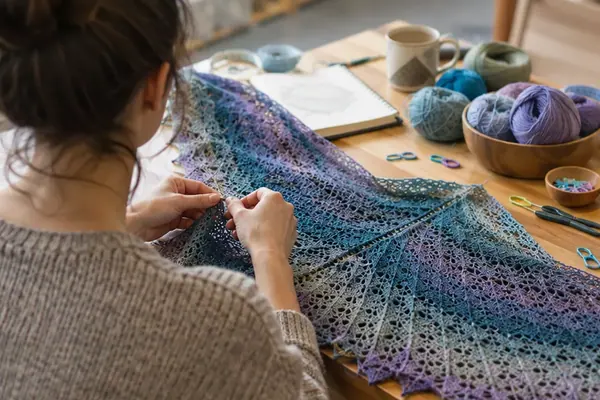
The independent dyeing expansion beginning around 2011 changed the scene. Dyers began producing highly variegated and speckled yarns in small batches. These vibrant colorways required expansive sections of garter stitch to breathe. Complex lace motifs simply disappear in rapid color shifts—a reality that necessitated a new type of pattern.
The 'vanilla' canvas was born. This structurally simple design approach became a proven method for highlighting hand-dyed yarn without visual competition.
Criteria for Pattern Selection
Evaluating a shawl pattern requires looking past the sample photography. A truly beginner-friendly design relies on specific structural elements. Beginner criteria were set by excluding short rows and confirming reliance on kfb and M1 increases with repeating motifs of under ten rows. These constraints keep the knitting rhythm predictable.
Hand-dyed optimized patterns actively break up color pooling. Seed stitch, linen stitch, and strategically placed eyelets disrupt the color blocks. Finding the optimal gauge allows these textured stitches to drape correctly.
Note: Highly contrasting micro-stripes may still pool unpredictably depending on the exact yardage and the knitter's specific tension.
Accessories offer significant gauge flexibility. A gauge tolerance of plus or minus two stitches per four inches for accessories ensures the final piece remains wearable. Exact stitch counts matter far less here than they do in fitted garments. Knitters can reference standard yarn weight classifications to substitute yarns confidently.
Evaluated Pattern Profiles
Ongoing pattern testing since 2019 confirms that shape dictates color behavior. Patterns were chosen after testing each shape with three variegated skeins to confirm color distribution across bias and eyelet placements.
1. The Asymmetrical Garter Triangle
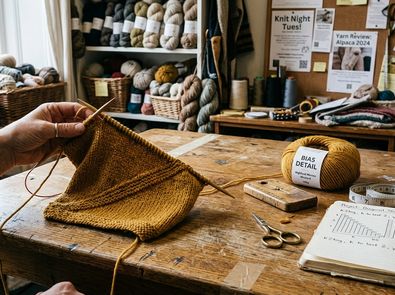
Bias knitting mechanics drive this popular shape. The knitter increases on one edge and decreases on the other. This creates a diagonal grain across the fabric. That diagonal grain prevents harsh color pooling in highly variegated skeins—even those with abrupt color changes. Because the single-row repeat is so easy to memorize, the shape stays highly accessible.
2. The Top-Down Crescent
Crescent shawls sit securely on the shoulders. This shape relies on an expansion rate of eight stitches every right-side row in the crescent shape. The rapid widening creates long, elegant wings. A stockinette body paired with a simple picot bind-off provides a smooth surface. This construction is ideal for tonal or lightly speckled yarns.
3. The Bias Rectangle Wrap
Straight edges combined with a diagonal stitch direction create a woven look. The bias rectangle wrap offers a guaranteed disruption of highly contrasting colorways. The geometry forces the yarn to travel across the fabric at an angle. This constant shifting breaks up any potential color stacking.
Initiating Your First Project
Preparation dictates the success of the final fabric. Initial steps were sequenced to start with center-pull winding followed by needle upsizing to produce the required drape. Hand-dyed yarn typically arrives in a twisted hank. Winding your chosen hand-dyed skein into a center-pull cake using a swift and ball winder prevents tangling.
Quick Tip: Place a locking stitch marker directly on the right side (RS) of the fabric to easily track your increase rows without needing to read the knitting.
Fabric drape requires room for the stitches to relax. Cast on the first five rows of your selected pattern using a circular needle one size larger than recommended on the yarn's ball band. This needle upsizing ensures a draped, airy fabric.
Mount your swift to a sturdy table edge, secure the yarn loop, and wind your first skein into a center-pull cake before casting on.

Discussion
No comments yet. Be the first!
Write a Comment