
Linen has a reputation problem in sweater knitting. It gets praised for market bags, summer tanks, and crisp crochet lace, then quietly pushed aside when the conversation turns to seamless sweaters.
That habit deserves a second look. A well-built top-down garment asks for stability, clean drape, and enough strength to carry its own weight without sagging into a tired shape. Wool answers those needs with bounce. Properly processed linen answers them with architecture.
In this Article
- Why fiber memory is not the only measure of sweater structure
- How long line flax changes durability and pilling behavior
- What wet-spun processing does for stitch definition
- Why double-boil finishing matters for softness and temperature comfort
- How Louet Euroflax compares with familiar wool palettes
- A step-by-step seamless linen sweater workflow
Rethinking Fiber Memory: Why Linen Outperforms Wool in Seamless Architecture
The first try-on can be confusing. A linen yoke does not hug the shoulders the way wool does. It does not spring back after a tug, and it will not forgive a sloppy neckline just because the fiber has crimp.
That sounds like a drawback until the sweater settles. Then the strength of linen becomes obvious: the fabric hangs with intention. In a seamless top-down pullover, especially one with a circular yoke or raglan shaping, that steady vertical drape can make the garment look less homemade in the best possible sense.
The useful question is not, “Does linen behave like wool?” It does not. The better question is, “Can linen support the architecture of a seamless sweater?” When the yarn begins with tall flax, is spun under controlled conditions, and is finished carefully at the mill, the answer can be yes.
For top-down construction, flax plants over about 36 inches are the practical starting point because length affects the integrity of the spun strand. Spinning conditions matter too. Linen handled in roughly the 18 to 22 degrees Celsius range behaves differently from a yarn rushed through rougher handling. The mill process then decides whether the final skein feels wiry, papery, smooth, or quietly alive in the hand.
Note: Linen’s lack of elasticity is not a flaw to ignore. It is a design condition. A seamless linen sweater needs firm edges, deliberate gauge work, and blocking before judgment.
The Structural Advantage of Long Line Flax
Long line flax starts with plants growing over a yard tall. That height is not a romantic farm detail; it is the backbone of the yarn.
Picture a knitter holding two swatches after a week of wear. One has a faint halo and little pills forming where the underarm rubbed against the body. The other still shows the columns of knit stitches cleanly. The difference often begins long before the skein reaches the yarn shop wall.
Longer flax fibers mean fewer fiber ends in the spun yarn. Fewer ends give abrasion fewer places to catch. In yarn from stems close to 40 inches, reduced ends per meter translate into a smoother, stronger thread, which matters when the finished garment carries more weight than a scarf or a small accessory.
That weight is where seamless construction gets demanding. A pieced sweater distributes stress through seams. A top-down seamless sweater asks the yarn itself to carry the neckline, yoke, shoulders, and body as one continuous fabric. The yarn must tolerate gravity without looking exhausted.
Timing after retting also matters. Stems processed within roughly three days after retting retain a cleaner path from plant to fiber. In practical yarn reviews, that shows up as less fuzz, more consistent hand, and a strand that feels firm without becoming harsh.
Why fewer fiber ends matter on the body
Pilling is not only cosmetic. Pills catch light, blur stitch definition, and make a smooth stockinette sweater look older than it is. On a seamless linen pullover, reduced pilling helps preserve the vertical lines that make the fabric elegant.
Strength is the other half of the story. A linen sweater over a meaningful finished weight needs tensile steadiness, not bounce. That is where long line flax earns its place beside wool in serious sweater planning.
Processing Mechanics: Wet-Spun vs. Dry-Spun Yarns
Two linen skeins can share the same fiber name and behave like different tools. Dry-spun linen often feels rougher and more uneven, with a rustic surface that can suit home goods, open crochet, or deliberately textured knitting patterns. It has character, but character is not always what a seamless yoke needs.
Wet-spun linen takes another route. During spinning, the fibers pass through water, heat, and humidity so the strand smooths as it forms. In the processing profile used here, wet-spun fibers pass through a water bath around 60 degrees, while dry-spun yarn is completed at ambient humidity, roughly 40 to 50 percent.
That difference lands directly on the needles.
Dry-spun linen: texture first
Dry-spun yarn can be beautiful in the right project. It reads earthy. It can make a simple stitch feel old-world and tactile. But in a seamless sweater, the unevenness can distract from increases, short rows, neckline shaping, and raglan lines.
Wet-spun linen: definition first
Wet-spun yarn offers a smoother finish, which helps each stitch sit where the pattern expects it to sit. That matters in seamless construction because the shaping is visible. A raglan line is not hidden in a seam allowance. A yoke increase does not disappear into assembly. The fabric is the construction.
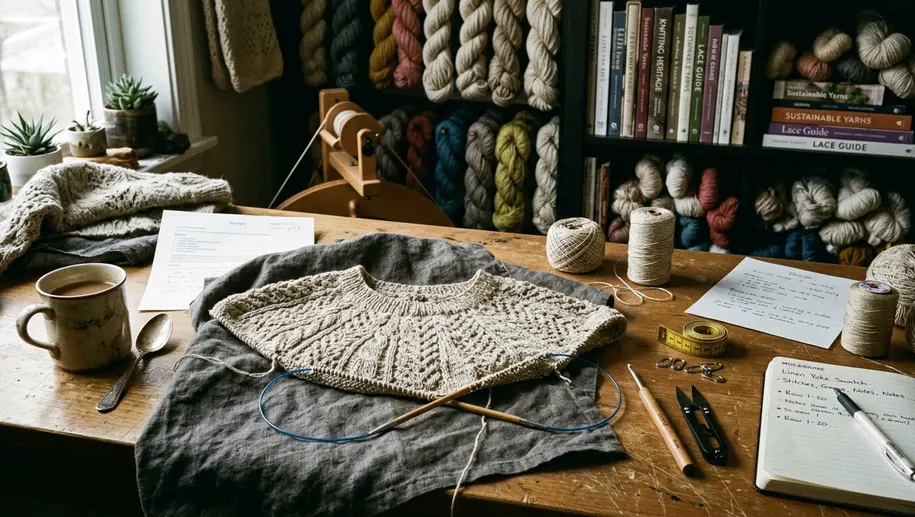
For makers who love techniques and tutorials, this is the lesson worth carrying forward: the spinning method is not trivia. It changes how cleanly a neckline holds, how visible the increase rhythm looks, and whether the finished sweater feels crisp or scratchy after blocking.
Quick Tip: If a linen yarn feels uneven in the skein, knit a small shaped swatch rather than a plain square. Include increases or a mock raglan line so the fabric answers the actual sweater question.
The Double-Boil Method and Pectin Preservation
Soft linen is not accidental. It is engineered through handling, water, temperature, and restraint.
The double-boil mill process used for fine linen yarns splits flax fibers more finely and softens the resulting strand. In the processing notes for this evaluation, the double-boil cycle is held near 95 degrees for about 45 minutes. The goal is not to erase linen’s personality. It is to refine it enough that a sweater can sit comfortably at the neck, shoulder, and elbow.
There is a temptation to treat softness as the only prize. That misses the more interesting part: pectins. These natural components in flax contribute to linen’s heat-regulating feel when they are retained through careful processing. Pectin retention was checked after the 2022 harvest, which matters because linen is still an agricultural material, not a laboratory clone.
This is why a good linen sweater can work across more than one season. It does not trap warmth like a lofty woolen yarn. It does not collapse like a limp plant-fiber blend. It sits in that useful middle ground: breathable on a warm afternoon, substantial enough over a shirt when the room cools.
Color absorption varies with seasonal harvest, and so can the final hand. That does not make the yarn unreliable. It simply reminds the knitter to judge linen as linen, with its own standards for comfort, movement, and wear.
Material Analysis: Louet Euroflax
Louet Euroflax is one of the cleanest case studies because it has been treated as a benchmark long line linen since its early-2000s acquisition. It shows what happens when the yarn is not positioned as a novelty summer fiber but as a serious garment material.
On the skein, Euroflax can look almost too disciplined. The strand is smooth. The colors are clear. It does not have the cushioned bloom that wool shoppers may expect when they squeeze a hank in the shop.
That first impression changes after blocking. The fabric relaxes, the surface softens, and the stitches begin to look less like rows of thread and more like cloth.
Euroflax beside Louet Gems
Louet’s Euroflax palette was matched to its Gems wool line in the 2021 update, which gives knitters a familiar bridge between animal and plant fibers. A maker who knows the wool color family can choose a linen shade without starting from zero.
The match, however, is not visual sameness. This comparison is narrow: it speaks to palette alignment, not identical dye behavior across fiber types. Plant fibers and animal fibers absorb dye differently, so Euroflax may appear cleaner, flatter, or more reflective where Gems reads rounder and deeper.
That difference can be an advantage. In cables, the linen version may look sharper but less shadowed. In stockinette, the color can feel architectural. In lace, especially open summer lace used at a sleeve or hem, the smoothness lets the negative space do real work.
One thing to keep in mind: Euroflax is not a wool substitute. It is a disciplined long line linen that rewards knitters who block, measure, and let the finished fabric speak after drying.
Executing a Seamless Linen Knit: A Step-by-Step Application
The workflow below is scoped to seamless garments over roughly 300 grams finished weight. Smaller accessories can be more forgiving. A full sweater is where linen’s structure, processing, and edge control matter most.
Step 1: Swatch, then block harder than feels reasonable
- Knit a generous swatch in the stitch pattern that dominates the sweater body.
- Include a small area with increases if the design uses raglan shaping or a circular yoke.
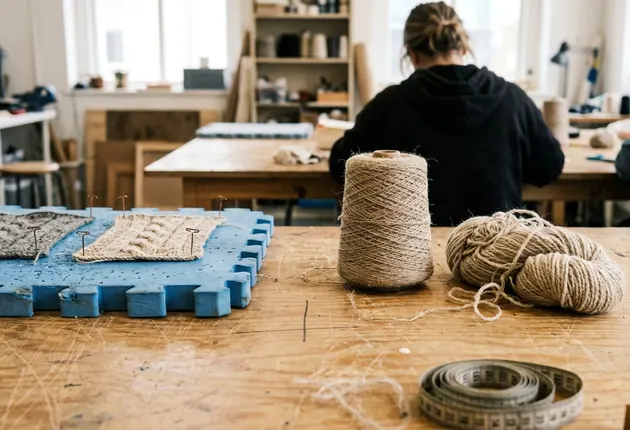
- Soak and block the swatch firmly, treating it like finished fabric rather than a quick gauge check.
- Leave the blocked swatch undisturbed for about a day after knitting before measuring.
This step accounts for the softening bloom created by double-boil processing. Linen can look narrow and stubborn while it is being knitted, then relax into a more honest fabric after water and time. Measuring too early is how sweaters become longer, wider, or looser than planned.
Step 2: Anchor the neckline with a firm cast-on
- Use the pattern’s neckline stitch count.
- Cast on with a 4.0 mm needle at firm tension.
- Avoid a stretchy cast-on unless the pattern specifically solves for linen’s lack of elasticity.
- Join carefully, then work the first rounds without tugging the stitches open.
The neckline is the load-bearing edge of a top-down linen sweater. Wool can rebound after a loose cast-on. Linen will remember the looseness and display it.
Step 3: Build the yoke with visible discipline
- Place markers exactly where the pattern calls for shaping.
- Work increases with steady tension rather than tightening them to “help” the linen behave.
- Pause after the first shaped section and spread the fabric flat on a table.
- Check whether the increase lines look clean before continuing into the body.
For a copyable case, take a top-down raglan pullover planned in wet-spun long line linen: knit and block the swatch for a full day, choose the needle that gives the blocked gauge, cast on the neckline stitches with a 4.0 mm needle at firm tension, join without twisting, place the four raglan markers, work the yoke increases as written, then lay the yoke flat before separating the sleeves so the linen’s smooth stitch definition can confirm the sweater is on track.


Discussion
No comments yet. Be the first!
Write a Comment