
Which blocking method actually produces the best drape on a full-size crochet blanket? Not on a tidy little square you pin to a mat and admire, but on something big enough to fold over the arm of a sofa and hang under its own weight. That is the question this case set out to answer, and it needed real blankets to answer it honestly.
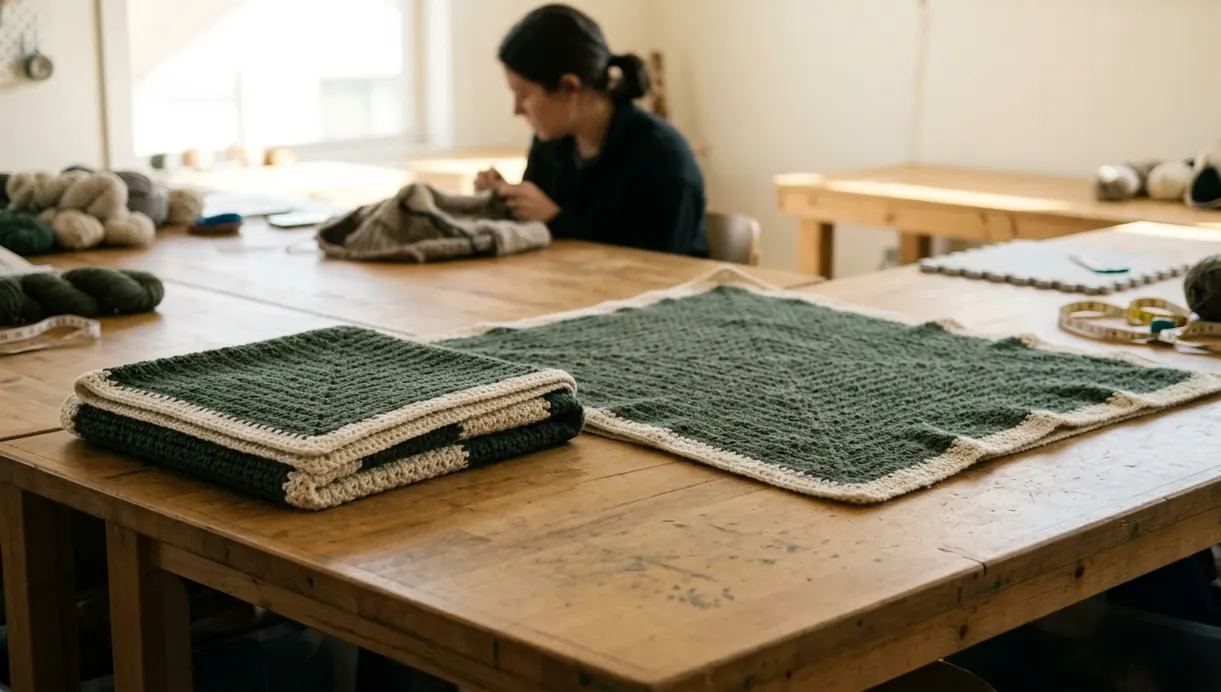
So two finished pieces went under the pins and the steam. The first was a worsted-weight wool throw, 52 by 64 inches, worked in repeating lace-and-solid panels. The second was a heavy acrylic afghan, 48 by 60 inches, built from dense cluster fabric that stood almost on edge before finishing. Two fiber classes that between them cover most of the large crochet finishes people bring to a workshop table.
The original plan was tidier: wet-block both, compare, done. That plan lasted about as long as it took to remember that acrylic does not bloom. Soaking a synthetic blanket gets you a wet synthetic blanket and a very long drying time. The fiber decides the method, which is why the two blankets were finished by two different routes and judged on the same three things: how the fabric hangs, how straight the borders sit, and how open the stitch windows stay.
What follows is the whole sequence, timings included, plus the small test I now consider non-negotiable before anyone commits a finished blanket to water or heat.
Scales, Filaments, and Why One Bath Will Not Do
Blocking failures in this niche almost always start in the same place: treating acrylic like wool. So the fiber structure comes first, before any technique.
Wool is covered in overlapping cuticle scales. Wet those scales in warm water and they lift and relax; as the fiber dries in a held position, they settle back down and lock the new shape in place. That is why wool blooms — the stitches swell into their neighbors, the gaps between them fill, and a lace motif that looked cramped on the hook suddenly reads as deliberate negative space. Wool remembers what you told it while it was wet.
Acrylic has no scales to lift. It is a continuous extruded filament, which is a polite way of saying it is plastic thread. Water does nothing structural to it. Heat does. Warm the filament enough and it relaxes and re-sets in a softer, heavier configuration, and that new configuration stays until you apply heat again.
The unblocked baseline
Before either blanket was touched, the hand of each was logged, because "it looks better" is not a finding without a starting point.
- Wool throw, unblocked: borders felt boardy and stiff along the edge; the lace windows sat half-closed, so the pattern read as texture rather than as openwork.
- Acrylic afghan, unblocked: a dry squeak when the fabric was rubbed against itself, and a fold that sprang back within two to three seconds of being creased. Nothing about it wanted to drape.
Those two baselines are the yardstick the rest of the case is measured against.
The Wool Throw Goes Into the Bath
Every handling decision on the wool side was sequenced around one risk: felting. Agitation plus heat plus soap is how you turn a throw into a mat, and it takes surprisingly little enthusiasm to get there.
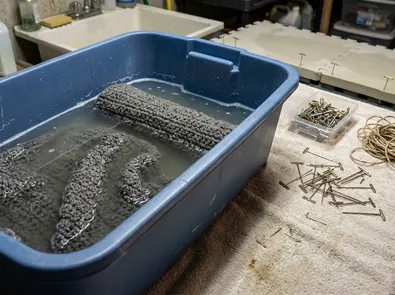
The bath was drawn at 88 to 94 degrees Fahrenheit with a capful of unscented wool wash. Lukewarm, close to skin temperature, with no shock in either direction when the throw went in. The blanket was lowered and pressed gently under the surface, then left completely alone for 14 to 18 minutes. No swishing, no kneading, no lifting it half out to check on it. A still soak.
Getting the water out is where most damage happens. The throw was gathered into a loose bundle and lifted with both hands supporting its full weight, never dangling from one corner, because a soaked worsted blanket is heavy enough to stretch its own stitches on the way to the towel. It was then laid on a towel, rolled, and pressed. Pressed, not wrung. Wringing twists the fibers against each other and that is the exact motion felting wants.
Pinning to the lace, not to a measurement
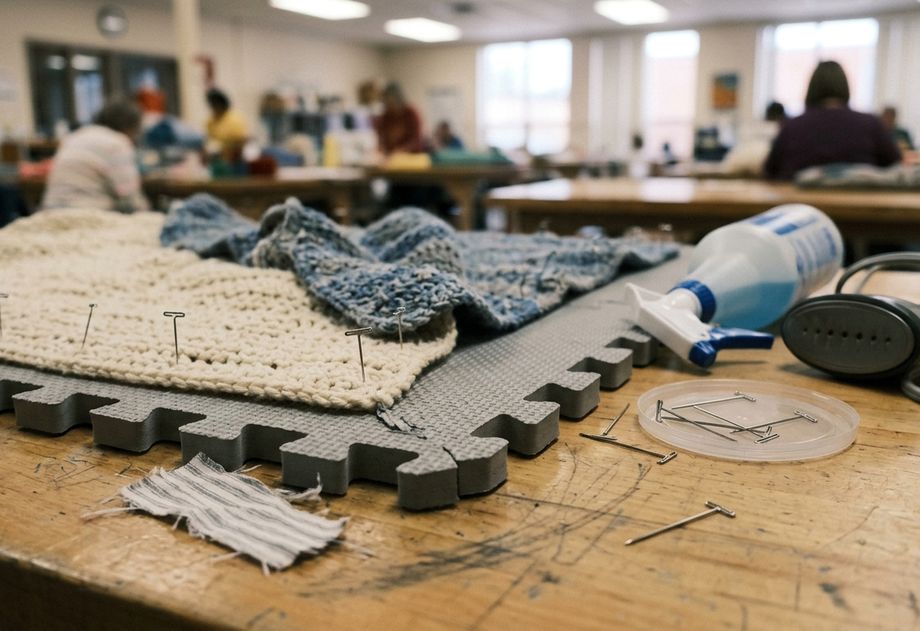
The damp throw went onto interlocking foam mats, and here the tension was decided by eye rather than by tape. Border pins were set every one and a quarter to two inches, working from the corners inward, easing the edge into a straight line rather than yanking it to a target width.
The lace panels set the stopping point. Each motif was opened only until the window read clearly, then pinned. Overstretching wet wool locks in a thin, lifeless fabric that looks stretched forever after, and you cannot un-pin your way out of it once it dries.
Drying took 36 to 48 hours in still indoor air at 68 to 72 degrees. That long tail matters more than it sounds: the throw's lace motifs did not finish at pin-out. Stitch bloom and the filling of the negative space arrived gradually, as the last of the soak water left the wool. Checking at hour six would have told you almost nothing.
Pin Tension Rule
Stop pulling the moment a lace window looks open. If you are still tugging to hit a number on a tape measure, the wool is already past where it should be, and dry wool holds that overstretch permanently.
Hovering Heat Over Dense Cluster Fabric
The acrylic afghan needed a completely different setup: a flat, heat-safe surface large enough to take a full zone of fabric at once, with the blanket laid smooth and left unpinned across the field. Light pins went in only where the border waved.
Hover distance was the control variable for the whole session, because plate contact is the fast route to ruining the piece. The steamer head was held one to two inches off the fabric, moving steadily, with the metal plate kept off the yarn from the first pass to the last.
Work proceeded in zones. Each zone got 8 to 12 seconds of steam, then a pause while the heat left that area before the adjacent pass began. That rhythm is the safeguard. Steam that has somewhere to go relaxes the filament; steam that stacks up in one spot keeps climbing until the fiber gives.
The squeak disappeared on the first pass. That is the tell that the filament has started to relax, and it happened well before anything looked stressed.
The Point of No Return
"Killing" acrylic means pushing heat until the fibers melt into a limp, shiny, permanently dead fabric. There is no reversing it. The band this case worked inside was a one-to-two-inch hover with 8-to-12-second zonal passes; direct metal-plate contact was never part of what was tried on the afghan. If your steamer wants to touch the yarn, you are already off the map.
How the Two Blankets Hung Once Dry
Three scoring criteria, applied to both pieces: hang, edge line, stitch windows.
The wool throw came off the pins with a border that held a straight line on its own, no rippling, no memory of the boardy edge it started with. The lace windows stayed open once dry, and the stitch definition sharpened noticeably against the solid panels. Structured is the honest word for the result: a fabric with a crisp perimeter that still folds softly through the body.
The acrylic afghan gained something different. Once fully cool, it hung with a heavy, even fluidity that the unblocked cluster fabric could not have produced at any tension. The fold that used to spring back in two to three seconds simply stopped springing back. It did not gain crispness; it gained weight and flow.
Longevity splits by fiber
This is the part that changes how you plan a project. The wool throw is a reset-after-wash fabric: the next full wash releases the shaping, and it will need re-blocking each time. The acrylic drape from this steam session is set. Barring another heat event, that hand is now permanent.
A scope note is owed here. Both blankets were worsted weight, and both were single-fiber. Lace-weight yarns and wool-acrylic blends were not part of this pairing, and they open, stretch, and set on different clocks — a blend in particular can take a partial bloom from water and a partial set from heat, which makes its behavior harder to predict from either of these results alone.
What Actually Transfers
Wet blocking buys wool structure and open stitch windows, renewable at every wash. Steam blocking buys acrylic a permanent heavy drape in a single session. Choose the finish based on which of those two outcomes your blanket needs, and on nothing else.
Your 6 × 6 Gate Before You Wet a Whole Blanket
Here is the concrete next step, and it comes before your next blanket, not after.
Crochet a 6 by 6 inch swatch in the exact yarn you plan to use, then run your intended blocking method on it in full. Six inches is large enough to show a motif opening and a border flaring, and small enough that you can throw it away without grief if the yarn dies or grows past recovery. Yarn brands differ in ply structure, twist, and dye treatment, and none of that is visible in the ball band.
The critical rule: the swatch takes the same protocol the blanket will take, not a gentler proxy. A cautious half-test tells you nothing about how the full-strength treatment will behave. You want the swatch to fail in exactly the way the blanket would.
6×6 swatch gate before the blanket
- Crochet a 6 by 6 inch swatch in the project yarn, using the same hook and the same tension you will work the blanket at.
- Measure across one motif and along one edge while the swatch is still unblocked, and write both numbers down.
- For wool: run the full 14-to-18-minute lukewarm soak at 88 to 94 degrees with wool wash, press between towels, pin, and let it dry the complete 36 to 48 hours.
- For acrylic: run the one-to-two-inch hover with 8-to-12-second zonal passes, then let the swatch cool fully before you touch a tape measure to it.
- Re-measure the same motif and the same edge, and compare against your unblocked numbers to get your real growth figures.
- Drape the swatch over your hand and over a table edge. If the hand is wrong, change the method or the yarn now, while it costs you one small square.
Cast that swatch on tonight, before you wind the rest of the skeins. Six inches of yarn and one drying cycle is the price of knowing exactly what your blanket will do.
Discussion
No comments yet. Be the first!
Write a Comment