
Translating the Spring Landscape into Stitches
Mid-April on a weathered limestone porch in Fredericksburg offers a masterclass in color theory. The wind moves through dense patches of bluebonnets and Indian paintbrushes, creating a chaotic blur of vibrant hues. Capturing this exact scene requires swatching royal blue and sage green wool directly against the view. This direct observation anchors the translation of organic natural beauty into structured, mathematical knitting grids.
The distinct geological and botanical features of Central Texas provide a unique framework for stranded knitting and intarsia. Translating these elements into wearable art demands a rigorous approach to pattern design. Every stitch serves a structural purpose. The translation process begins with graphing paper and colored pencils, mapping the organic curves of petals onto a rigid grid. Every square represents a single stitch, forcing a compromise between natural fluidity and geometric reality.
While crochet offers its own structural benefits, knitting provides the precise grid necessary for these specific botanical charts. Community & events across Central Texas often showcase these regional designs, highlighting the deep connection between maker and environment.
Criteria for Selection: Evaluating Regional Motifs
Authentic representation relies on precise color palettes, focusing on key regional elements:
- The chalky white of local limestone paired with deep rust Enchanted Rock granite.
- The vibrant blue of Lupinus texensis.
- The muted sage greens of native grasses.
Reading thorough yarn reviews helps identify the right twist for crisp stitch definition. Ongoing collaborations with regional indie dyers over the past few years help ensure these specific shades translate accurately to the skein. The deep rust of the granite isn't a flat color; it contains flecks of mica and quartz. Replicating this requires heathered or tweed yarns rather than solid dyes.
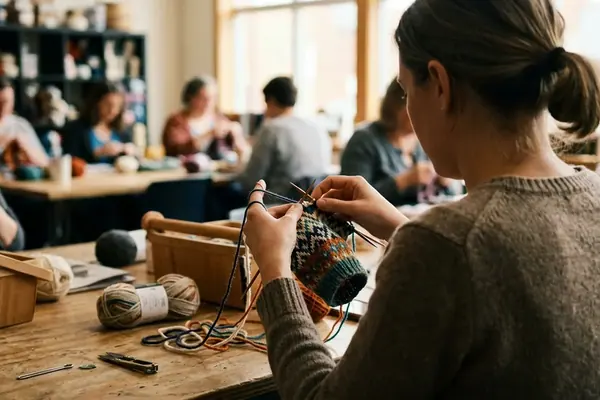
Technical execution dictates the success of stranded colorwork. While tension standards vary by knitter, and structural analysis of garment interiors highlights tension issues, the general finding is that floats longer than about 5-7 stitches require careful catching. This presents a known limitation for beginner knitters.
Note: Floats longer than 5-7 stitches require catching to maintain fabric elasticity and prevent snagging.
Motifs must fit naturally into the garment's architecture. Vertical wildflower motifs worked into yoke shaping must accommodate the natural increases of the sweater without distorting the gauge. The mathematics of a circular yoke require periodic increase rounds. Placing these increases within a vertical motif without disrupting the stem or petal shapes demands precise charting. Proven grading techniques ensure the botanical elements grow organically across all sizes.
The Curated Collection: 4 Essential Hill Country Patterns
The intersection of tools & notions with regional inspiration yields distinct design challenges. Exploring these specific knitting patterns reveals how different techniques solve unique structural problems.
1. The Bluebonnet Yoke Sweater
Traditional stranded colorwork forms the foundation of this design. The primary challenge lies in managing three colors in a single row to achieve the white-tipped peaks of the bluebonnets. Artificial intelligence pattern generators often overlook dominant yarn management when three colors meet in one row. Human hands must guide the tension. Success here relies entirely on keeping the background yarn subordinate to the motif colors.
Quick Tip: Consistent dominant yarn management guarantees the white tips of the floral motifs pop against the background fabric.
2. Limestone & Live Oak Cowl
Mosaic knitting techniques offer a different approach to texture. Slip-stitch patterns effectively mimic the rough, deeply grooved bark of ancient live oaks against smooth limestone. This method produces a highly textured fabric, and it requires only one color worked per row. Because mosaic knitting slips stitches from the previous row, the fabric compresses vertically. The resulting cowl provides plenty of warmth without the bulk of traditional stranding.
3. Pedernales River Wrap
Large, sweeping blocks of turquoise and deep green represent the flowing water through an intarsia approach. This technique is strictly restricted to flat knitting only. Attempting intarsia in the round creates a structural nightmare. The flat construction allows the river motifs to meander across the fabric without the distortion of circular joins. Managing multiple bobbins of yarn across a wide wrap requires patience and careful untangling at the end of every row.
4. Sunset Gradient Hat
Capturing the fading light over the hills requires precise color transitions. However, dye lot shifts in fingering wool disrupt gradient transitions on hats. Careful skein alternation mitigates this risk. Alternating rows between two skeins of the same colorway smooths out any harsh lines, preserving the illusion of an unbroken sunset.
Selecting Your Landscape
Mastering these designs requires both strict tension control and a deep appreciation for the source material. The techniques & tutorials applied to these projects elevate basic stitches into regional portraits.
Summary: Highly detailed botanical motifs demand fingering or sport weight yarns to maintain clarity and scale.
Scope limitations dictate yarn choice. Attempting these intricate designs in bulky weights will result in pixelated, unrecognizable shapes—a frustrating outcome after hours of careful charting. A motif that looks elegant over thirty stitches in fingering weight becomes a massive, blocky shape in bulky weight, entirely losing its delicate botanical context. The delicate structure of a wildflower simply cannot be rendered in thick wool.
Will you tackle the precise, three-color stranding of the spring wildflowers, or surrender to the sweeping, structural intarsia of the riverways for your next cast-on?


Discussion
No comments yet. Be the first!
Write a Comment